

Showing all 3 results
A diving knife belongs in the same category as a buoy and a buddy: you need it before you need it. Entanglement in monofilament fishing line, discarded netting, or dense kelp is rare — but when it happens, it happens at depth, with a limited breath-hold, and with no time to think. A knife that draws cleanly, cuts reliably, and can be reached with one hand is the correct response to that scenario.
What a Freediving Knife Is For
The primary function of a diving knife in freediving is entanglement cutting. Monofilament fishing line — nearly invisible underwater — is the most common hazard: a diver moving over a reef or rocky bottom can become caught on a discarded line in seconds. Abandoned fish traps, ghost nets, and kelp present similar risks. In each case, the knife is the tool that resolves the situation quickly enough for the breath-hold to remain safe.
For spearfishers, a knife serves a second purpose: dispatching and handling catch. A quick, clean kill is both more humane and produces better-quality fish. The Barracuda camouflage variants, with their larger blade and robust construction, are designed with this dual-use requirement in mind.
A knife is not a primary tool in recreational freediving — it sits in its sheath throughout most sessions. But its secondary status does not reduce the requirements: it must be instantly accessible, reliably deployable, and sharp enough to cut immediately. A dull knife that requires multiple strokes to cut monofilament is not a safety tool.
The Knives in This Range
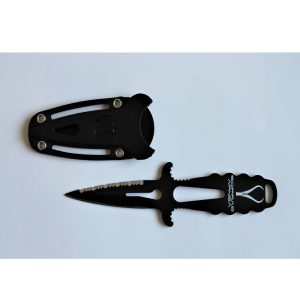
The APNEA knife is a compact freediving knife available in two variants. It is designed for the standard freediving use case: low profile, secure mount, one-handed draw. Stainless steel blade resists saltwater corrosion with regular maintenance. The compact size keeps it unobtrusive without adding drag during a streamlined descent.
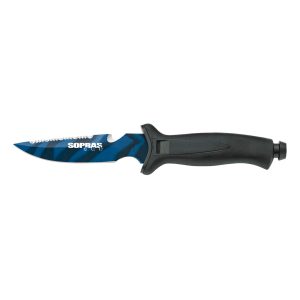
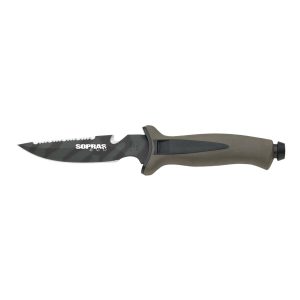
The Barracuda camu blue and Barracuda camu green are larger, more robust knives with camouflage-patterned handles suited to spearfishing. The green camouflage finish suits temperate water and rocky coastal environments; the blue suits open water and Mediterranean conditions. Both have sufficient blade length and thickness for handling larger fish, while remaining appropriate for emergency entanglement cutting.
Carry Position and Accessibility
Where you carry your knife matters as much as which knife you choose. The three standard positions are wrist/forearm, calf/thigh, and buoy or line attachment. Wrist carry is the most accessible — you can reach a wrist-mounted knife with either hand without changing body position. Calf carry is popular with spearfishers who prefer to keep the knife clear during active swimming but need it accessible when working fish. Buoy attachment is used when the knife is primarily a backup rather than an everyday carry.
Whatever position you choose, test the draw before diving: reach the knife with your non-dominant hand, draw it with gloves on, draw it in a horizontal body position. If any of these scenarios reveals a problem — difficult draw, unstable sheath, knife shifting position — address it on land before relying on it in the water.
What to Look For
- One-handed draw in any body position. The fundamental requirement. Test draw your carry knife with gloves on and at depth-equivalent postures before trusting it in the water. A knife that requires two hands or a specific grip angle is inadequate for emergency use.
- Stainless steel blade with corrosion resistance. Marine-grade stainless resists saltwater corrosion significantly better than standard cutlery steel. Maintenance is still required, but the baseline durability is appropriate for regular marine use.
- Sheath retention without impeding draw. The sheath needs to hold the knife securely enough that it does not shift during active movement, but releases cleanly with the correct single-motion draw. Test both — a sheath that holds too tightly in cold water can be as problematic as one that releases too easily.
- Blade geometry for cutting cordage. A partially serrated blade handles the widest range of entanglement scenarios — smooth edge for clean cuts on monofilament, serrated section for sawing through thicker rope or netting.
Maintenance and Care
Rinse the knife and sheath with fresh water after every saltwater session. Remove the knife from the sheath for drying — a sheath that stays wet against a blade accelerates corrosion at the contact points even on stainless steel. Dry both completely before storage.
Sharpen the blade regularly. A sharp knife is safer than a dull one: it requires less force and cuts entanglement material quickly enough to be genuinely useful in an emergency. Test periodically on a piece of monofilament — if it requires effort or multiple attempts, sharpen before the next dive.
Apply a light coat of silicone oil or light machine oil to the blade before extended storage. This protects the steel surface from oxidation without contaminating the sheath material or affecting cutting performance when put back into use.
Check sheath retention regularly. Salt and sand accumulate in sheath mechanisms and change their behaviour — a retention clip that held firmly when new can become sticky or loose after extended saltwater use. Adjust or replace before the problem becomes critical.
FAQ
Where should I carry my knife?
Wrist or forearm carry is the most accessible position for emergency use and is recommended for most freedivers. Calf carry works well for spearfishers who prefer to keep the knife away from their hands during fin work. The key test is accessibility with your non-dominant hand while horizontal and under mild exertion.
Is the APNEA knife or Barracuda better for general freediving?
The APNEA knife is the more appropriate choice for pure freediving where the knife is a safety backup. It is smaller, lighter, and lower profile. The Barracuda variants are better suited to spearfishing where the knife also serves as a fish-handling tool — the larger blade and heavier construction are useful for dispatch work but unnecessary if the knife will spend most of its time in the sheath.
Do I need a knife for pool freediving?
In a standard pool environment with no lines or netting, the entanglement risk that justifies carrying a knife is essentially absent. Most pool and dynamic apnea training is done without a knife. For open-water freediving, a knife should always be part of your kit.
What’s the difference between the Barracuda blue and green camouflage?
The difference is purely aesthetic — blade geometry, steel, and sheath system are equivalent between the two variants. Barracuda camu green is patterned for temperate and rocky coastal environments; camu blue suits open water and warmer sea conditions. Choose based on your typical spearfishing environment or personal preference.
How often should I sharpen a diving knife?
Test the blade at the start of each season and after any session where you have actually used it to cut something. The practical test is whether the blade cuts cleanly through a piece of monofilament with a single draw — if it requires effort or multiple attempts, sharpen before the next dive.