

Showing all 6 results
Some of the most important pieces of freediving equipment don’t fit neatly into a single category. This section covers freediving lanyards — the connection between a diver and the line during depth diving — along with a dive flag, a neoprene thermo holder, and a suit button for open-cell neoprene repairs. Small items, but each one with a specific function that more general gear cannot replace.


Freediving Lanyards: Function and Design
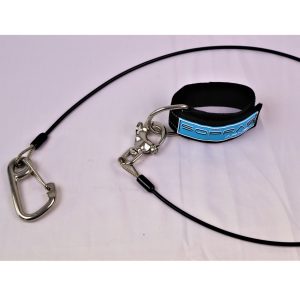
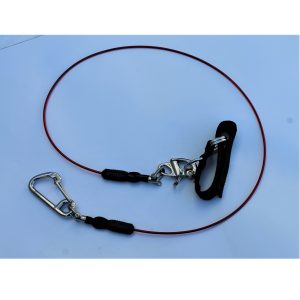
A freediving lanyard connects the diver’s wrist to the dive line during constant weight and free immersion diving. Its purpose is twofold: it provides the diver with a passive connection to the line during freefall, and it allows the safety diver and rescue team to locate and pull the diver to the surface rapidly in an emergency without having to physically search for them in the water column.
The critical design requirement of a freediving lanyard is its release mechanism. A lanyard that cannot be released quickly is a hazard rather than a safety tool. All three lanyards available here use different release mechanisms suited to different diving contexts.
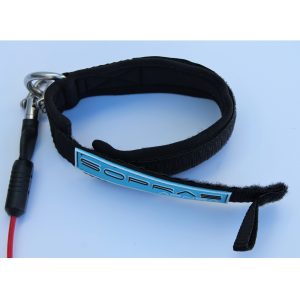
The Freediving lanyard with velcro release uses a velcro-based wrist cuff that opens with a single pull. It is the simplest and most intuitive option — no mechanical component to learn or maintain. Appropriate for recreational depth diving and training sessions where the forces on the lanyard are moderate and the release is typically performed at the surface.
The Freediving lanyard with quick release snap link uses a mechanical snap link that releases with a single motion. The snap link is more reliable under load than velcro — if the diver needs to be pulled to the surface under tension, a mechanical release is less likely to fail from the force involved. This is the preferred option for divers training at greater depths or in competitive contexts.
The FD lanyard w.QR buckle no 360 turret uses a quick-release buckle without the 360° rotating turret found on some competition lanyards. The turret, when present, prevents the lanyard from winding around the line during rotation in freefall — its absence makes this lanyard better suited to divers who maintain a stable body position without significant rotation, or where simplicity is a priority.
The Other Items
The Flag is a standard dive flag for attachment to a buoy, surface board, or float. In many countries, displaying a dive flag when divers are underwater is a legal requirement. Even where it is not mandatory, a flag dramatically increases the visibility of your dive position to passing boats.
The Neoprene thermo holder is a small neoprene sleeve for keeping a drink warm (or cold) at the water’s edge. Not a piece of diving equipment in any technical sense, but a practical item for long sessions — a hot drink between dives maintains core temperature and makes cold-water sessions significantly more comfortable. Available in two sizes.
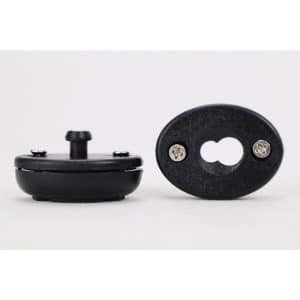
The Plastic button for FD suit is a replacement closure button for open-cell freediving suits. The button-and-loop closure system used on the hood connection of most two-piece freediving suits is a common failure point — buttons crack or snap, loops stretch and fail. Having a replacement is straightforward preventive maintenance. The repair requires neoprene glue and a few minutes, and keeps the suit functional without sending it back to the manufacturer for a minor closure repair.
What to Look For
- Lanyard release mechanism matched to your diving context. Velcro for recreational and training use; mechanical snap link for greater depths and competitive context. Test whichever mechanism you choose with one hand, with gloves, and in a horizontal position before using it in the water.
- Lanyard length and attachment point. A lanyard that is too short restricts arm movement; one that is too long creates slack that can tangle. Most freediving lanyards are designed to attach at the wrist with enough length for natural arm extension during descent without excess.
- Dive flag visibility. A flag serves no purpose if it is too small to see from a moving boat. Standard freediving flags are sized for adequate visibility from 50–100 metres in calm conditions. In rough water or areas with heavy boat traffic, a larger flag or one with reflective elements improves safety.
Maintenance and Care
Rinse lanyards with fresh water after saltwater use and allow to dry completely. Pay particular attention to the release mechanism: salt in a velcro surface reduces its grip; salt in a mechanical snap link or buckle can cause sticking. For mechanical releases, a rinse and occasional application of silicone lubricant maintains smooth operation.
Inspect lanyard line or webbing for fraying or wear, particularly at attachment points. A lanyard that is pulled during a rescue scenario is subjected to significant force — a worn line is not adequate for this use.
The neoprene thermo holder requires only an occasional rinse. Neoprene develops odour if left wet and sealed — rinse, squeeze out water, and leave open to dry after each use.
FAQ
Is a lanyard required for recreational freediving?
For recreational open-water diving to moderate depths with a safety partner, a lanyard is recommended but not always mandatory. It becomes effectively required for depth training beyond approximately 20–25 metres, and is required by rule in all competitive freediving disciplines. Even recreationally, a lanyard significantly speeds up rescue response time — the safety diver can pull the diver to the surface immediately rather than searching for a grip in low-visibility conditions.
What’s a 360° turret and do I need one?
A 360° turret is a swivel connector that allows the lanyard to rotate freely at the line attachment point. During freefall, some divers rotate slowly around the vertical axis — without a turret, this winds the lanyard around the line, creating tension and restricting movement. If you rotate during freefall, a turret is valuable. If your descent is stable without rotation, the QR buckle without turret is adequate and simpler.
Where is the dive flag attached?
The flag attaches to the highest point of your surface setup — typically a pole or upright on the buoy, or a mast on a surface board. It should be visible from all directions and elevated enough to be seen above small waves. Some torpedo buoys include a flag attachment point; for round buoys, a separate flag pole or bracket is typically needed.
How do I replace a button on my freediving suit?
Remove any remnants of the old button and clean the attachment area with isopropyl alcohol. Apply neoprene contact cement to both the button base and the suit attachment point, allow to tack for 5–10 minutes, then press together firmly. The bond is immediate — position the button correctly before pressing. Allow 24 hours for full strength before stressing the closure.
Can I use the velcro lanyard for competitive freediving?
Competition rules vary by organisation, but most competitive freediving bodies (AIDA, CMAS) specify minimum requirements for lanyard release mechanisms. Velcro-release lanyards may not meet competition specifications at all levels — check the current rules for your target competition before using this variant. For AIDA-sanctioned events, a certified lanyard meeting their specific requirements is typically required.