

Showing all 10 results
A surface marker buoy is the single most important piece of safety equipment a freediver brings to open water. It marks your dive position for passing boats, gives your safety partner a fixed reference on the surface, and provides a rest point between dives. Without a buoy, you are effectively invisible to surface traffic — and your safety team has no anchor point to work from if something goes wrong underwater.
For more buyos and liftbags please check SoprasSub.
Types of Freediving Buoys and Their Use Cases
Not all surface buoys serve the same purpose, and the right choice depends on where and how you dive. The range here covers four distinct categories: compact torpedo buoys for spearfishing and light use, professional-grade freediver buoys for training and open-water sessions, large dive centre buoys for multi-diver setups, and surface boards that combine buoyancy with a platform for resting and gear storage.
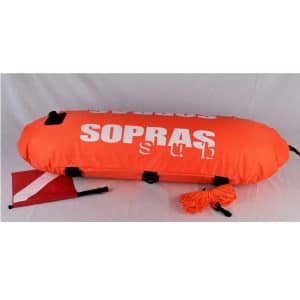
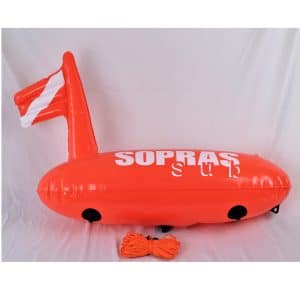
The Buoy Torpedo spearfisher and Buoy Torpedo with flag are compact, streamlined buoys designed to be towed behind a spearfisher without creating significant drag. The torpedo shape sits low in the water and moves efficiently — a large, round buoy tethered to a moving diver creates resistance that accumulates over a long session. The torpedo variant with flag adds a dive flag for legal compliance in jurisdictions that require one, and for visibility in areas with boat traffic.
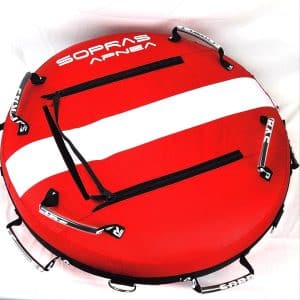
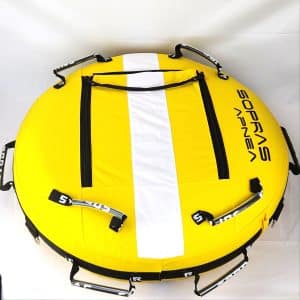
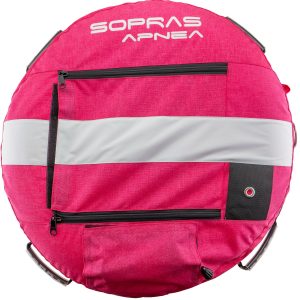
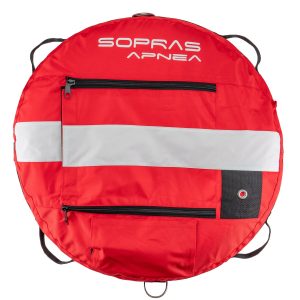
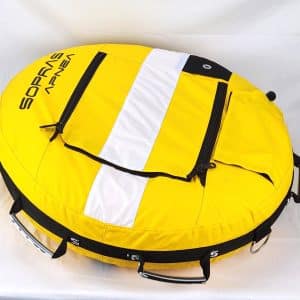
The Freediver buoy in red, pink, and yellow are full-sized freediving buoys with a stable profile suited to stationary diving setups — you drop your line from the buoy, dive vertically beneath it, and return to it between dives. These provide the volume and stability to hold a weighted line taut in moderate sea conditions. The yellow variant includes an over-pressure relief valve (OPRV), which prevents the buoy from rupturing if internal pressure builds — relevant in hot climates or when inflating in cool water before leaving the buoy in direct sun.
The DIVE CENTER freediving buoy in red and yellow is a larger, more robust buoy intended for professional and instructional use. These are the appropriate choice for dive centres running group training sessions, for safety setups with multiple divers on a single line, or for open-sea conditions where a smaller buoy would be inadequate.
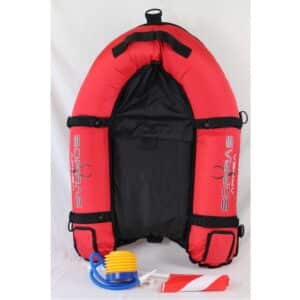
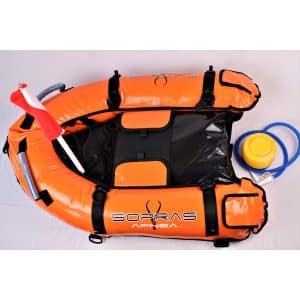
The Inflatable surface board and New patrol board are flat, inflatable platforms rather than traditional buoys. They serve a different function: a diver can climb onto the board to rest between dives, store small items, or use it as a staging point for equipment. In spearfishing, a board is common for holding catch, weight belt, and snorkelling gear between dives. The patrol board is a larger, stiffer platform designed for more demanding conditions.
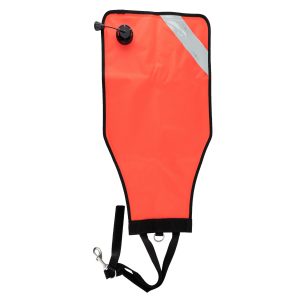
The Small lift bag rounds out the category. Lift bags are inflated underwater and used to bring objects to the surface — anchors, lost equipment, boat lines. It also functions as an emergency surface marker if deployed from depth.
Buoy Selection by Diving Context
For recreational open-water freediving with a fixed line, a standard freediver buoy is the correct choice. The line attaches to the buoy ring, the bottom weight keeps it vertical, and the buoy stays in position while you dive. Choose a colour that contrasts with the water in your usual diving area — yellow is highly visible in blue water; red stands out against haze.
For spearfishing, a torpedo buoy towed on a float line keeps your position marked without hampering movement. You are covering horizontal distance rather than diving vertically beneath a fixed point, so drag and manoeuvrability matter more than line attachment capability.
For training with an instructor or safety diver, or any setup involving multiple divers, a dive centre buoy provides the volume and stability to handle multiple lines and the additional surface load of two or more divers resting simultaneously.
What to Look For
- Volume and stability in your typical conditions. A small buoy that gets pushed underwater by moderate waves provides no safety value. If you regularly dive in open sea or exposed conditions, prioritise buoys with larger volume and a stable elongated shape over compact models.
- Over-pressure relief valve (OPRV) for hot climates. Buoys inflated in cool conditions and left in direct sun can over-pressurise. An OPRV prevents rupture by releasing excess pressure automatically — relevant anywhere temperatures vary significantly between morning setup and midday use.
- D-ring or attachment ring quality. The point where your line attaches to the buoy takes repeated load as the buoy bobs and the line pulls. A poorly reinforced attachment point will eventually tear. Check that the ring is set into a reinforced patch rather than directly through the buoy material.
- Dive flag inclusion or attachment point. In many countries, displaying a dive flag when divers are in the water is a legal requirement. The Torpedo with flag variant includes one; for other buoys, check whether a flag mount is present or can be added.
- Inflation and deflation speed. A buoy that takes five minutes to inflate properly is a problem when you arrive at the site and want to get in the water quickly. Wide-bore valves that inflate efficiently make a real difference on the water.
Maintenance and Care
Rinse buoys with fresh water after every saltwater session, paying attention to valves and attachment points where salt tends to accumulate. Deflate partially — not fully — for storage, as fully deflated material folds under its own weight and can develop permanent creases that weaken the material over time.
Store away from direct UV exposure and heat. PVC and coated nylon both degrade under sustained UV, and heat accelerates pressure-related wear on valves. A bag or storage cover significantly extends buoy life.
Inspect valves before each session — a slow leak that goes unnoticed on land becomes a problem when the buoy is far from shore. Check by inflating fully and leaving overnight; any significant loss of firmness indicates a valve or seam issue that needs addressing before the next dive.
For buoys with over-pressure relief valves, test the OPRV periodically by inflating beyond normal operating pressure and confirming the valve opens and reseals correctly. A stuck OPRV that fails to open under pressure defeats its purpose entirely.
FAQ
Is one buoy enough for a two-diver freediving session?
For most recreational setups, yes — one buoy with a single line is standard for a diver/safety pair. The safety diver stays at the surface near the buoy while the other diver descends. For setups where both divers want to take turns diving from the same rig, a larger buoy with two attachment points is more practical. Dive centre buoys are designed with this in mind.
What’s the difference between a surface board and a standard buoy?
A standard buoy is primarily a depth marker — it floats, holds your line, and is visible. A surface board is a platform you can physically rest on or use to store gear. It provides much more surface area and load capacity, but is larger, slower to set up, and not appropriate for use with a weighted vertical