

Showing the single result
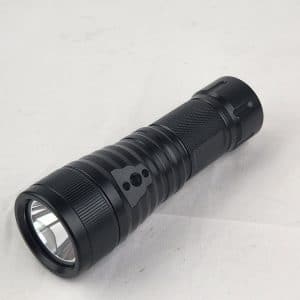
A dive torch is not standard kit for every freediver — but for spearfishing at dawn or dusk, night freediving, or exploring darker reef structures where ambient light does not reach, a compact, high-output torch is essential rather than optional. The SY 25 is the torch in this range: a powerful, narrow-beam handheld designed around the specific requirements of breath-hold diving, where size, output, and simplicity matter more than burn time measured in hours.
Why Freediving Torches Are Different
Scuba diving torches are designed for continuous use over 45–90 minute bottom times, sometimes with canister batteries, goodman handles, or bolt-snap attachment systems. Freediving requires none of this. A freediver carries a torch in one hand for the duration of a single breath-hold — typically 1 to 4 minutes — and the torch is switched off during surface recovery. This intermittent pattern means that battery capacity requirements are far lower than in scuba, and that size, weight, and grip matter far more than runtime.
Every gram and every centimetre of cross-section affects streamlining during the duck dive, freefall, and ascent. A torch that is too large forces the hand into an unnatural position that disrupts the diver’s profile. A torch that is too heavy shifts the diver’s trim. The ideal freediving torch is one that disappears in the hand — compact enough to ignore when not pointing at something, and bright enough to illuminate a target clearly when it is.
The SY 25 — 3,000 Lumens in a Compact Body
The SY 25 delivers 3,000 lumens through a narrow beam — a high output figure for a handheld torch of this form factor. The narrow beam angle concentrates the light into a focused spot rather than dispersing it over a wide flood area, which provides significantly better throw and target illumination for the applications freedivers actually use a torch for: scanning crevices, holes, and ledge undersides during spearfishing, and maintaining orientation during night dives.
At 3,000 lumens with a narrow beam, the SY 25 is capable of illuminating targets at considerable distance in clear water. In reduced visibility, the focused beam cuts through particulate more effectively than a wide-angle flood, which scatters light back toward the diver and reduces effective range.
Torch Use in Freediving Contexts
Spearfishing is the most common context for freediving torch use. Fish shelter in holes, under ledges, and in crevices during daylight and are significantly more accessible — and less alert — at dawn and dusk when light levels drop. A powerful, focused torch illuminates these locations without requiring the diver to approach closely before assessing whether a target is present.
Night freediving requires a torch for basic orientation and safety. In the absence of ambient light, depth perception and directional awareness at depth depend entirely on the torch beam. A buddy system with both divers carrying torches allows each to track the other’s position during the dive and on the surface. The beam is also visible to surface support and boats at considerable distance, improving safety in busy or low-visibility conditions.
Reef exploration in shallow, clear water does not always require a torch — but accessing the underside of coral structures, sea caves, and deeper reef zones benefits from a focused beam even in good ambient light conditions.
What to Look For
- Compact body for single-hand grip. A torch for freediving should fit comfortably in a closed fist without the fingers being forced to an extreme position. A body diameter of 35–45 mm and a total length under 150 mm is the practical target range. Oversized torches impose a drag penalty and are tiring to hold on longer dives.
- Narrow beam, not wide flood. A focused spot beam of 8–12 degrees concentrates output at range, which is what spearfishers and night divers need. A flood beam is more useful for close-range scuba cave inspection than for the longer-range target acquisition that characterises freediving torch use.
- Output of 1,500–3,000 lumens. This is the practical range for compact freediving torches. Below 1,000 lumens the beam struggles in anything other than clear, shallow water. Above 3,000 lumens, heat generation and battery drain become limiting factors without a meaningful gain in most freediving applications.
- Reliable one-handed switch operation. The switch must be operable with the hand that holds the torch, without the diver needing to transfer the torch between hands or use both hands. A recessed button or positive-click twist switch prevents accidental activation in a pocket or float vest.
- Wrist lanyard. The lanyard is not optional for freediving use. During duck dives, surface entries, and any moment where both hands are needed, a torch without a lanyard will be lost. Ensure any torch used for freediving is rigged with a wrist lanyard before entering the water.
Maintenance and Care
Rinse the SY 25 thoroughly with fresh water after every saltwater session. Pay specific attention to the switch area, the O-ring groove at the head, and the battery compartment threads. Salt accumulation at the threads makes the head difficult to open for battery access and, over time, scores the O-ring surface.
Inspect the O-ring seal each time the battery compartment is opened. Remove the O-ring, wipe the groove clean, check for surface nicks or trapped particles, and apply a thin film of silicone grease before reassembly. A single grain of grit on the O-ring is sufficient to cause a flood — do not assume the O-ring is intact without physically inspecting it.
Remove the battery if the torch will not be used for more than a few weeks. Store the cell at 50–70% charge in a cool, dry environment. Lithium-ion cells stored fully charged or fully depleted for extended periods lose capacity and can swell, which may jam the battery compartment.
Test the torch before every diving session. A torch that flickers or fails to illuminate on full power has a weak battery or a contact problem — identify and resolve this on land, not at the dive site.
FAQ
Do I need a torch for daytime reef freediving?
In clear, shallow water with good ambient light, no — a torch is optional. But for any diving that involves scanning darker structures, holes, or ledge undersides, even a daylight session benefits from a focused torch. The SY 25’s output is strong enough to be useful even in bright ambient conditions where lesser torches are washed out by natural light.
How long will the SY 25 last during a freediving session?
Freediving torch use is intermittent — the torch is on during the dive and off during surface recovery. A torch rated at 2–3 hours of continuous burn time will cover a full session of normal freediving practice. For very long sessions or multi-session days, carry a spare battery as a precaution.
Can I hold the torch during the duck dive?
Yes — and this is the normal technique. Hold the torch in one hand with the wrist lanyard in place and perform the duck dive and descent normally. The torch is gripped loosely in the palm during descent with the beam pointed downward or forward; the grip tightens when actively scanning a target. A lanyard prevents loss if the grip relaxes during freefall.
Is the SY 25 suitable for night freediving without a buddy?
A torch is a required piece of night freediving equipment, but it does not replace a safety buddy. Night freediving without a surface safety diver significantly increases risk regardless of torch capability — disorientation, blackout, and entanglement risks all increase at night, and a diver underwater cannot be seen from the surface without a light source and someone watching for it. Always dive with a safety buddy at night.
What is the depth rating of the SY 25?
Check the product page for the current specified depth rating. As a general rule, any torch intended for freediving use should be rated to at least 50 metres to provide an adequate safety margin beyond the depths most recreational freedivers reach. Torches rated only to 10 or 20 metres are swimming and snorkelling tools, not diving equipment.