

A freediving suit is not just thermal protection — it is a performance tool. Every element of its construction, from the interior cell structure that seals against your skin to the exterior coating that slides through the water column, directly affects your warmth, hydrodynamics, flexibility, and depth comfort. The right suit lets you relax fully during breathe-up, descend with minimal drag, and stay warm through extended sessions without adding unnecessary bulk or restriction.
-
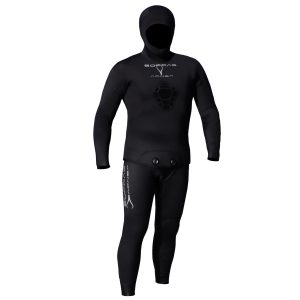
Open cell standard (9)
-
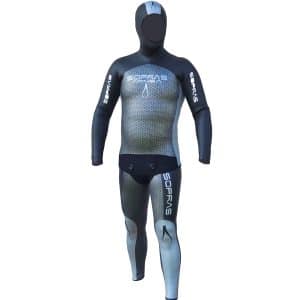
Smooth, glide, mesh skin (12)
-
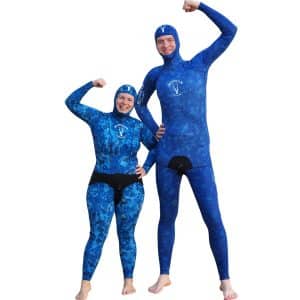
Open cell freediving suits made to measure (6)
-
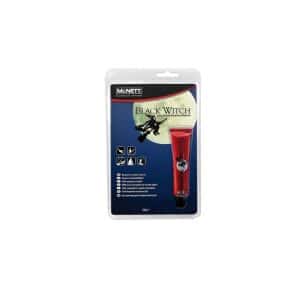
Neoprene glues (2)
Why Your Suit Matters More Than You Think
Water conducts heat roughly 25 times faster than air. Even in warm tropical water, a freediver who spends an hour cycling through breathe-ups, dives, and recovery will lose body heat steadily. Cold triggers peripheral vasoconstriction, increases oxygen consumption, and accelerates the mammalian dive reflex in ways that can shorten comfortable bottom time and compromise relaxation — the single most important factor in breath-hold performance.
Freediving suits are fundamentally different from scuba wetsuits. They use softer, more elastic neoprene that compresses more evenly at depth, offers greater stretch for diaphragmatic breathing and full arm extension, and recovers its shape better over time. The standard design is a two-piece suit: high-waisted pants and a hooded jacket with a beaver-tail or overlap closure. This two-piece construction creates a double layer across the torso for extra insulation where heat loss is greatest, while minimising water entry at the waist compared to a one-piece.
Freediving Suit Categories
Neoprene Glues
Specialised contact cements and adhesives for repairing open cell and smooth skin neoprene. Freediving suits are inherently fragile, and field repairs with the right glue can save an expensive suit from a small tear becoming a write-off.
Open Cell Standard
The workhorse of freediving wetsuits. Open cell (uncoated raw neoprene) interior adheres directly to the skin with a near-vacuum seal. Exterior is lined with durable nylon fabric for abrasion resistance and ease of care. The best balance of warmth, durability, and value.
Smooth, Glide, Mesh Skin
Suits with a treated exterior surface instead of fabric lining. Smooth skin and glide skin provide maximum hydrodynamics and wind resistance. Mesh skin adds a micro-textured diamond pattern for improved tear resistance while retaining most of the drag reduction. All three prioritise performance over durability.
Open Cell Freediving Suits Made to Measure
Custom-tailored suits built from your body measurements. A made-to-measure open cell suit delivers the tightest possible fit — which in freediving directly translates to better thermal insulation, less water flushing, and no excess material to create drag or restrict movement.
Open Cell Interior: How It Works
The defining feature of a freediving suit is its open cell interior. During manufacturing, a block of neoprene is sliced to expose the internal cell structure — thousands of tiny open pores that, when pressed against skin, create individual micro-suction points. The result is a near-airtight seal between suit and body. Water essentially cannot flow between the neoprene and your skin. Instead of heating a water layer (as in a lined scuba wetsuit), your body heats only the neoprene itself, which acts as a direct insulator.
The thermal advantage is dramatic. A well-fitting 5 mm open cell suit can keep a diver comfortable for 40–50 minutes in water near 0 °C. The same thickness in a standard lined wetsuit would leave the diver shivering within minutes. However, this performance comes with trade-offs: open cell neoprene is fragile, tears easily from fingernails or rough handling, and requires lubricant (diluted conditioner, soapy water, or a dedicated wetsuit lube) to put on. You cannot pull on an open cell suit dry — it will stick to your skin immediately and tear.
Exterior Surface Types
The exterior of a freediving suit determines its hydrodynamics, durability, and resistance to environmental damage. Three main surface types exist, each with a distinct set of trade-offs.
Lined (nylon exterior) is the most durable option. A fabric lining bonded to the outside of the neoprene protects against abrasion, UV degradation, and minor impacts. Lined suits are available in solid colours and camouflage patterns, dry quickly on the fabric side, and tolerate reef contact and rough handling far better than unlined suits. The downside is increased drag in the water and a slight cooling effect from wind evaporating water trapped in the fabric when you surface. For spearfishing, recreational freediving, and training, lined exteriors are the practical choice.
Smooth skin (also called glide skin or super skin) is the exterior of choice for performance freediving and competition. The neoprene surface is heat-treated or coated to create a slick, sealed finish with virtually no surface texture. Water slides off it, reducing hydrodynamic drag to a minimum. Smooth skin also blocks wind effectively — after surfacing, the suit dries almost instantly and does not cool the diver through evaporation the way a fabric-lined suit does. The disadvantage is extreme fragility. Smooth skin tears from fingernail contact, brush against coral or rock, UV exposure, and even improper storage where surfaces stick together. These suits are reserved for line diving, competition, and careful use where environmental contact is minimal.
Mesh skin is a relatively recent innovation that bridges the gap between smooth skin and lined exteriors. The neoprene surface is processed with a fine knurled diamond pattern — a micro-textured grid that retains much of smooth skin’s hydrodynamic advantage while significantly improving resistance to cuts, tears, and abrasion. Mesh skin is a practical choice for divers who want better glide than a lined suit but need more durability than pure smooth skin — particularly on the legs, where contact with rocks, boat ladders, and gear is more frequent.
Off-the-Rack vs Made to Measure
Standard-size freediving suits work well for divers whose body proportions match the manufacturer’s size chart. But neoprene is not forgiving of poor fit. A suit that is too loose in any area allows water to circulate between the open cell interior and the skin, destroying the vacuum seal that provides insulation. A suit that is too tight restricts chest expansion and diaphragmatic breathing — directly limiting lung capacity and dive performance.
A made-to-measure suit is built from 15–25 individual body measurements: height, chest, waist, hips, thigh, calf, arm length, neck circumference, and more. The suit is cut and assembled specifically for one body. The result is a fit that eliminates all excess material, maintains the open cell seal across every surface, and allows full range of motion without restriction. For serious freedivers — particularly those with body proportions that do not align with standard sizing — a custom suit is not a luxury but a necessity for thermal performance and comfort.
The process typically involves downloading a measurement form from the manufacturer, having a second person take the measurements with a flexible tape measure (self-measurement introduces too much error), and submitting the form with the order. Production time varies from 2 to 6 weeks depending on the maker. Accurate measurement is critical — a custom suit built from bad measurements will fit worse than an off-the-rack suit in the right size.
Neoprene Glue: Repair and Maintenance Essential
Open cell freediving suits will tear. It is not a question of if but when. A fingernail during donning, a graze against a rock, even storage with surfaces touching — all can produce tears ranging from cosmetic nicks to functional damage. The good news is that most tears are repairable at home with the right adhesive.
Neoprene contact cement is the standard repair adhesive. It is a flexible, black glue specifically formulated to bond neoprene to neoprene while maintaining the elasticity of the joint. The process is straightforward: separate the tear edges, clean both surfaces with alcohol, apply a thin coat of glue to each side, allow the first coat to dry for 1–2 hours, apply a second coat, wait 5–10 minutes until tacky, then carefully press the edges together. The bond is immediate and permanent — if pulled apart afterward, the neoprene will tear in a new location rather than at the repair.
Key principles for effective repair: fix tears as soon as possible before they spread or collect skin oils; use neoprene-specific glue (not generic super glue, which creates a rigid, inflexible spot that will re-tear under stress); black glue matches the open cell interior and remains invisible against the skin; and for tears that penetrate through to a lined exterior, reinforce the outside with an iron-on neoprene patch after the interior bond has cured. Keep a tube of neoprene glue in your dive bag at all times.
What to Look For
- Interior type — open cell is the standard for freediving. It provides the best thermal insulation by sealing directly against the skin. Lined interiors (nylon inside) are easier to put on but significantly less warm and allow more water movement.
- Exterior surface — lined for durability and spearfishing, smooth/glide skin for competition and maximum hydrodynamics, mesh skin for a practical compromise. Consider a hybrid: smooth skin jacket for upper-body glide and lined pants for leg durability.
- Neoprene grade — Yamamoto 45 is the benchmark for high-end freediving suits: excellent elasticity, low compression at depth, high resilience. Heiwa and NJN offer good performance at a lower price. Sheico and Ecoline are more durable but stiffer.
- Thickness — match the water temperature: 1.5–2 mm for pool and tropical water above 27 °C, 3 mm for 21–27 °C, 5 mm for 15–21 °C, 7 mm for 10–15 °C. Below 10 °C, use 7–9 mm or consider a drysuit. Choose the thinnest suit you can tolerate — less neoprene means less buoyancy change at depth and less weight required.
- Fit — the suit should feel like a second skin with no gaps, folds, or excess material anywhere. A poorly fitting open cell suit loses its primary thermal advantage. If standard sizes do not match your body, invest in made-to-measure.
- Two-piece design — the standard freediving suit is high-waisted pants plus hooded jacket with overlap at the torso. This provides double neoprene at the core, allows mixing thicknesses (thicker pants, thinner top or vice versa), and makes donning easier than a one-piece.
Maintenance and Care
Rinse after every session in fresh water. Salt, chlorine, and sand all degrade neoprene and accelerate ageing. If fresh water is not available immediately, keep the suit in a bag with some seawater rather than letting salt dry on it.
Turn the suit inside out to dry the open cell interior first — this is the side that traps moisture and is most prone to bacterial growth and odour if stored damp. Once the interior is dry, flip it and dry the exterior. Dry in shade only — UV radiation breaks down neoprene and is especially destructive to smooth skin surfaces, causing cracking and premature ageing.
Store the suit flat or on a wide hanger in a cool, dry place. Never fold a neoprene suit for extended periods — creases compress the cell structure and create permanent thin spots that reduce insulation. Never store an open cell suit with the interior surfaces touching — they will bond together and tear when separated.
For smooth skin suits, lightly dust the exterior with talcum powder before storage to prevent surfaces from sticking. Avoid contact with sharp objects, rough surfaces, and direct sunlight at all times.
Repair tears immediately using neoprene contact cement. Small repairs done quickly are invisible and permanent. Large tears left unrepaired will spread with each use.
Frequently Asked Questions
Why can’t I use a regular scuba wetsuit for freediving?
Scuba wetsuits use stiffer neoprene with fabric lining on both sides, which restricts the chest expansion needed for full diaphragmatic breathing and packing. They are also heavier, create more drag, and offer less thermal efficiency per millimetre of thickness because the lined interior allows water circulation against the skin. A freediving-specific open cell suit provides better warmth, flexibility, and hydrodynamics with less material.
How do I put on an open cell wetsuit without tearing it?
Always use a lubricant — diluted hair conditioner, soapy water, or a commercial wetsuit lube. Pour it inside the suit or apply it to your body. Slide into the suit gradually, using flat palms — never grip with fingertips or nails. Work the suit up in sections: feet, calves, thighs, hips. For the jacket, arms first, then over the head, then roll the torso down. Take your time. Rushing is the primary cause of tears.
What is the difference between smooth skin and glide skin?
The terms are often used interchangeably, though some manufacturers distinguish them. Both refer to a treated, slick neoprene exterior designed for reduced drag. Glide skin typically describes a specific smooth coating applied by certain manufacturers — functionally, both provide the same hydrodynamic advantage and share the same fragility and care requirements.
Is a made-to-measure suit worth the extra cost?
If standard sizes fit you well, an off-the-rack suit performs comparably. But if you have long arms, a short torso, wide hips relative to waist, or any other proportion that does not align with standard sizing, a custom suit will dramatically outperform a stock suit in both warmth and comfort. The open cell vacuum seal only works when the fit is precise — any gap or excess material breaks the seal and allows water in.
How long does a freediving wetsuit last?
With proper care, a quality open cell freediving suit lasts 2–4 years of regular use. Smooth skin exteriors degrade faster than lined ones, particularly with UV exposure. The neoprene itself gradually loses elasticity and insulation over time as the cell structure breaks down from repeated compression cycles at depth. Suits stored wet, in sunlight, or folded will degrade significantly faster.