

Spearfishing is one of the oldest forms of freediving — a discipline that demands patience, stealth, breath-hold control, and technical knowledge of the equipment. The speargun is the central tool, but the full range of spare parts, shafts, bands, reels, and tips that keep it functioning reliably is just as important. This category covers both: complete spearguns in two propulsion types, and the full spare parts inventory to maintain and customise them.
Two Speargun Types, One Category
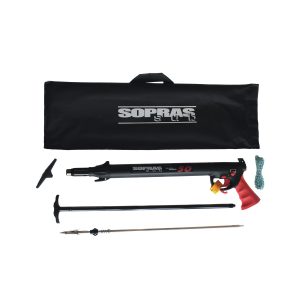
The spearguns available here represent the two dominant propulsion systems used in recreational and competitive spearfishing. Compressed air spearguns (pneumatic) store energy as pressurised air in the barrel, released on trigger pull to drive the shaft. Rubber band spearguns (also called band or sling guns) store energy in stretched latex bands loaded onto the shaft before the dive. Both systems are widely used, and each has a distinct character that suits different divers, environments, and hunting styles.
The Spare parts subcategory is the maintenance backbone for both types, with particular depth of inventory for pneumatic guns — shafts, tips, bands, pistons, reels, and hardware that keep a speargun in service for years rather than replacing the whole unit when a component fails.
Spearguns
Compressed air (pneumatic) spearguns in six lengths from 30 to 130 cm, and rubber band spearguns in multiple variants. Both types suit different hunting environments and personal preference.
Spare parts
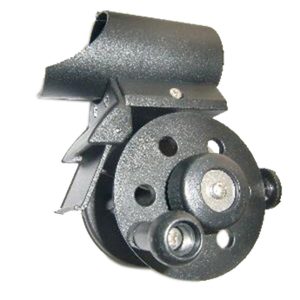
Full maintenance and customisation inventory: shafts, flopper tips, latex bands, piston sets, reels, loaders, wishbones, stringers, bungees, and all hardware needed to service and repair Sopras spearguns.
Pneumatic vs. Rubber Band: Key Differences
Compressed air spearguns are cocked by pushing the shaft into the barrel against air pressure, compressing the air charge. Power is determined by the pressure already in the gun — no loading effort at the surface is required, and the gun can be fired repeatedly without re-banding. They are generally quieter to fire than band guns, which matters for not spooking fish. The floating characteristic of the Sopras pneumatic guns means they rise to the surface if released, rather than sinking — a practical feature when a diver needs both hands free. Length options range from 30 cm for tight cave and crevice hunting to 130 cm for open water and larger pelagic fish.
Rubber band spearguns use one or more latex bands stretched from the muzzle to the shaft notch. Loading is done at depth or at the surface by pulling the bands back over the shaft — a physical effort that increases with the number of bands and their thickness. More bands mean more power and range. Band guns are generally more accurate at longer distances, easier to service in the field (a broken band can be replaced with a spare on the boat), and preferred by many experienced spearfishers for open-water hunting.
What to Look For
- Gun length matched to hunting environment. Short guns (30–50 cm) suit confined spaces — rocky reefs, caves, kelp beds — where a long gun cannot be manoeuvred. Medium guns (70–90 cm) are versatile for reef and shore diving. Long guns (110–130 cm) are appropriate for open water and larger fish where range matters more than manoeuvrability.
- Propulsion system matched to your style. Pneumatic guns suit divers who want consistent power without surface loading effort and prefer a quieter shot. Band guns suit divers who prioritise range and accuracy and are comfortable loading bands at depth. Both systems are fully viable — the preference is personal once you have experience with each.
- Spare parts availability. A speargun is only as reliable as your ability to replace worn components. The spare parts range here covers the full maintenance inventory for the Sopras pneumatic guns: shafts, pistons, tips, bands, reels, and hardware. Before buying a gun from any manufacturer, confirm that spare parts are readily available.
- Shaft diameter and tip compatibility. Shafts and tips must be matched — the shaft diameter determines which tip thread will fit, and the tip type (flopper single wing, flopper double wing, paralyzer) determines how the fish is held after the shot. Confirm compatibility before ordering spare shafts or tips.
Maintenance and Care
Rinse spearguns with fresh water after every saltwater session, paying particular attention to the trigger mechanism, muzzle, and any exposed metal fittings. Salt in the trigger housing causes corrosion that affects release feel and reliability over time.
For pneumatic guns, check the air charge periodically — a gun that loses pressure between sessions has a seal issue that needs addressing. The piston set and seals are the most common failure point and are available as spare parts. A hand pump is required to recharge the air chamber after servicing or pressure loss.
Latex bands for rubber band guns should be inspected before every session. Latex degrades under UV exposure and ozone, becoming brittle and prone to snapping under load. Store bands away from sunlight and replace them at the first sign of surface cracking or reduced elasticity. A band that snaps during loading can cause injury.
Shafts should be checked for straightness after any session where the gun fired into rock or hit a hard surface. A bent shaft does not track true and reduces accuracy significantly — replace rather than attempt to straighten a badly bent shaft.
Reels should be rinsed and the line checked for wear, particularly at the connection to the shaft and where it passes over the reel body. Salt-stiff line that does not pay out freely under load is a hazard — rinse and lubricate or replace as needed.
FAQ
Which speargun type is better for beginners?
Pneumatic guns are often recommended for beginners because loading effort is minimal — cocking the gun against air pressure requires less technique than loading multiple latex bands at depth. Shorter pneumatic guns in the 50–70 cm range are easy to handle and appropriate for most reef and shore spearfishing situations a beginner will encounter. Band guns become more attractive as experience and technique develop.
What does “floating” mean for the compressed air speargun?
A floating speargun is buoyant — if released, it rises to the surface rather than sinking. This is a safety and convenience feature: if a diver needs to release the gun to deal with a situation underwater (entanglement, blackout recovery, fish landing), the gun can be recovered at the surface rather than lost on the bottom. Most pneumatic spearguns with air-filled barrels are naturally buoyant.
How do I know which shaft fits my speargun?
Shaft diameter must match the barrel internal diameter of your specific gun. The shafts available here come in multiple diameter variants — check your existing shaft or the gun’s specification to confirm the correct diameter before ordering. Using the wrong diameter shaft will result in poor accuracy and potential damage to the barrel or trigger mechanism.
What is the difference between flopper single wing and flopper double wing tips?
Both tip types use a hinged wing (flopper) that folds flat during penetration and opens behind the fish to prevent the shaft from pulling back out. A single wing flopper has one hinged arm and is standard for most applications. A double wing flopper has two opposing arms, providing more retention force — preferred for larger, harder-scaled fish where a single flopper might not hold. The choice depends on the target species and water conditions.
Do I need a reel on my speargun?
A reel is not required for shallow reef spearfishing with a float line attached to a buoy. It becomes useful — and for some divers essential — when diving deeper, hunting in open water, or targeting species that run hard after being shot. A reel allows the diver to pay out line as the fish runs, rather than being pulled off course or having the shaft and line ripped free by a large fish. Two reel options are available here: one for pneumatic guns and one for rubber band guns.