

Showing all 2 results
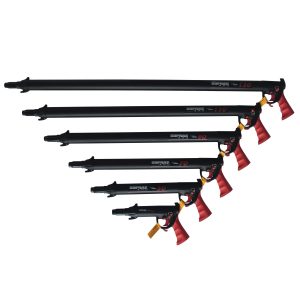
Two complete spearguns covering the two main propulsion systems used in spearfishing: a compressed air (pneumatic) speargun in six length options from 30 to 130 cm, and a rubber band speargun in multiple variants. Both systems are proven across decades of spearfishing use — the choice between them comes down to hunting style, target species, and personal preference.
Compressed Air Spearguns
The Compressed air speargun operates on a pneumatic principle: the barrel is pre-charged with air, and cocking the gun pushes the shaft rearward against that air pressure, compressing it further. On trigger release, the compressed air drives the shaft forward with consistent, controlled force. The gun is floating — buoyant when released — which means it rises to the surface rather than sinking if a diver lets go underwater.
Available in six lengths: 30, 50, 70, 90, 110, and 130 cm. The length determines the effective range and the size of fish the gun is suited for. The 30 cm variant is a compact tool for hunting in tight spaces — caves, crevices, rocky structure where a longer gun cannot be aimed. The 50 and 70 cm versions are versatile mid-range guns suitable for most reef and coastal spearfishing. The 90 and 110 cm variants handle larger fish and longer shots on open reef. The 130 cm gun is a specialist tool for open-water and pelagic hunting where maximum range is the priority.
Pneumatic guns require periodic air pressure maintenance — the barrel should be checked and recharged using a hand pump (available in the Spare Parts subcategory) if pressure drops between sessions. The piston and seals are the main wear components; both are stocked as spare parts for straightforward in-field servicing.
Rubber Band Spearguns
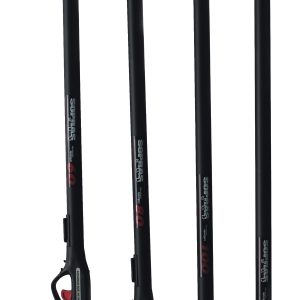
The Speargun with rubber band stores energy in stretched latex bands that are loaded onto the shaft notch before each shot. Loading is done by pulling the bands back over the shaft — a physical effort proportional to the number and thickness of bands. More bands increase power and effective range but also increase the loading effort and the time required to re-cock the gun after a shot.
Band guns are favoured by many experienced spearfishers for their accuracy at longer distances, simplicity of mechanism, and ease of field maintenance — a broken band can be replaced with a spare on the boat without tools. Available in multiple length variants to suit different hunting environments.
Choosing the Right Length
Length selection is the most important decision when choosing a speargun, and it is determined by where you hunt rather than personal preference. The principle is simple: use the shortest gun that gives you adequate range for your typical shot distance. A short gun in a confined space is accurate and manoeuvrable; the same gun in open water limits your effective range significantly. A long gun in kelp or on a rocky reef is impossible to aim and presents a safety risk.
As a general guide: rocky shore and reef diving in temperate water typically suits 50–70 cm guns; Mediterranean reef and mixed conditions suit 70–90 cm; open water and larger pelagic targets suit 90–130 cm. Divers who hunt varied environments often own guns in two different lengths for different conditions.
What to Look For
- Length for your primary environment. Match the gun length to your usual hunting conditions first. A gun that is well-matched to your typical dive site will outperform a theoretically superior gun that is the wrong length for the space.
- Propulsion system consistency. Pneumatic guns deliver consistent power on every shot regardless of how recently the gun was cocked — the air pressure is constant. Band guns can vary slightly in power depending on band tension and how recently the bands were loaded. For consistent accuracy at longer ranges, pneumatic guns have a slight advantage in this regard.
- Buoyancy for safety. A floating gun that rises to the surface when released is a meaningful safety feature in situations where a diver needs to use both hands or cannot control the gun. The compressed air speargun here has this characteristic by design.
- Spare parts access. Before committing to a speargun, confirm that shafts, tips, bands, and seals are available for it. The full spare parts range in the adjacent subcategory is stocked specifically for the Sopras speargun system.
Maintenance and Care
Rinse both gun types thoroughly with fresh water after every saltwater session. Pay particular attention to the trigger mechanism — salt in the trigger housing affects release feel and long-term reliability. Operate the trigger through several dry cycles after rinsing to clear water from the mechanism before drying.
For the pneumatic gun, monitor air pressure between sessions. A gun that loses pressure has a seal issue — the piston set available in Spare Parts is the correct replacement component. Recharge using the speargun hand pump after any servicing. Do not over-pressurise — follow the manufacturer’s recommended pressure for the specific gun length.
For rubber band guns, inspect latex bands before every session. Latex degrades under UV and ozone exposure; surface cracking or reduced snap-back elasticity means the band should be replaced before it fails under load. Store bands away from sunlight and heat between sessions.
Apply a light coat of silicone oil to the shaft before storage to prevent oxidation. Store spearguns unloaded — never store a cocked or loaded gun between sessions. Keep the muzzle pointed in a safe direction during loading and transport, and treat the gun as loaded at all times it is in the water.
FAQ
Can I use the compressed air speargun in a swimming pool?
Spearfishing with any speargun in a public swimming pool is not permitted. Pneumatic spearguns are designed for open-water spearfishing — reef, coast, and ocean. Pool use of spearguns is restricted to specific training facilities with appropriate safety infrastructure, and is not general practice.
How do I recharge the air in a pneumatic speargun?
The speargun hand pump available in the Spare Parts subcategory is the correct tool. It connects to the charging valve on the gun and allows precise pressure adjustment. The process involves unloading the gun first, attaching the pump, and charging to the recommended pressure for that specific gun length. Consult the gun’s documentation for the correct pressure — over-pressurising reduces accuracy and can damage the barrel or piston assembly.
How many bands does the rubber band speargun use?
The standard rubber band speargun configuration uses one or two bands depending on the length and the power desired. Single-band setups are easier to load and sufficient for most hunting distances. Double-band setups increase power and range but require more loading effort and slightly longer cocking time. The latex bands available in the Spare Parts subcategory are compatible with the band spearguns here — check the diameter variant that matches your gun’s muzzle configuration.
What length should I choose for Mediterranean reef spearfishing?
For typical Mediterranean conditions — rocky reef, posidonia grass, moderate visibility — a 70–90 cm gun covers the majority of situations. The 70 cm variant handles tighter structure and smaller fish; the 90 cm gives more range for open areas between structure and for larger target species. Many Mediterranean spearfishers use a 75 or 80 cm gun as their primary tool.
Is a reel necessary on the speargun?
For shallow reef hunting with a buoy and float line, a reel is not required. The line runs from the shaft to the buoy, and the buoy absorbs the run of a fish. A reel becomes useful when diving deeper than the float line allows, or when targeting species that make long hard runs after being shot. Reels for both speargun types are available in the Spare Parts subcategory.