


Showing all 9 results
Open cell standard freediving wetsuits represent the core of what most freedivers actually wear in the water. Built with an unlined open cell interior that adheres directly to skin, these suits offer a level of thermal efficiency that lined alternatives simply cannot match at the same thickness. If you freedive in water below around 24°C with any regularity, an open cell suit is the practical choice.
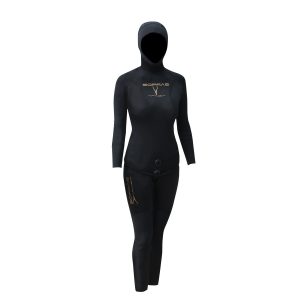
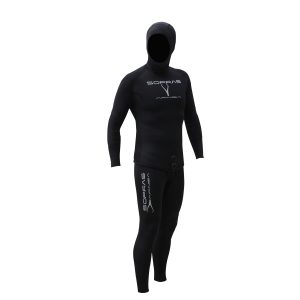
Why Open Cell Construction Dominates Freediving
Standard wetsuits — the kind used in scuba diving — use a fabric lining on the interior surface. That lining makes the suit easy to put on and more durable, but it introduces a gap between neoprene and skin that allows a constant slow exchange of water. For scuba divers who generate significant body heat through continuous movement, this is manageable. For freedivers who spend extended time motionless at the surface during breath-up and surface recovery, it is not.
Open cell neoprene solves this by leaving the interior surface of the neoprene unlined. The exposed cell structure acts like millions of microscopic suction cups, adhering directly to skin and forming a near-watertight seal. The result is a suit that traps a thin, rapidly warmed layer of water against the body and keeps it there. A well-fitting 3mm open cell suit typically provides equivalent warmth to a 5–7mm closed cell suit, which matters significantly when suit thickness directly affects buoyancy and flexibility at depth.
Construction and Fit
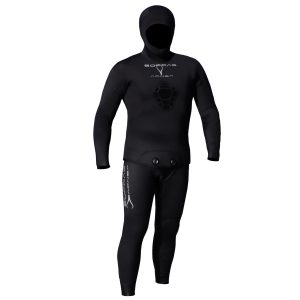
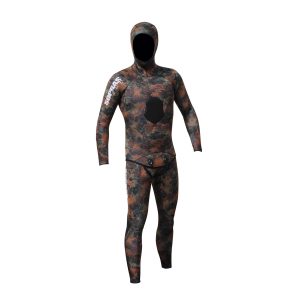
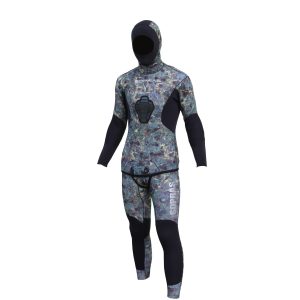
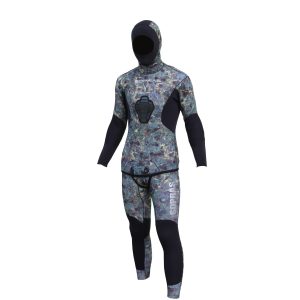
Open cell standard suits are typically constructed as a two-piece system — a hooded jacket and high-waist trousers — which allows overlap at the core, the area most critical for thermal protection. The hood is integrated into the jacket rather than being a separate accessory, eliminating a gap at the neck that would otherwise allow cold water entry. Seams are glued and blind-stitched rather than sewn through, as any needle penetration through open cell neoprene creates a water pathway that undermines the suit’s core function.
Fit is the single most important performance variable in an open cell suit. The seal only works when the neoprene is in continuous contact with skin — any gap, fold, or excess material breaks it. A correctly fitted open cell suit should feel snug throughout, with no bunching at joints and a secure seal at the face, wrists, and ankles. Because open cell neoprene stretches considerably more than lined neoprene, many freedivers size down from their standard wetsuit size.
Donning and Care
The adhesive interior that makes open cell suits thermally superior also makes them impractical to put on dry. The standard method is to wet both the suit interior and the body with a lubricating solution — warm water with a small amount of conditioner or baby shampoo is widely used — before donning. Attempting to pull an open cell suit on dry will tear the interior surface. Neoprene glue is an essential companion item for any open cell suit owner, as small tears at stress points (wrists, ankles, neck seal) are normal over time and straightforward to repair if addressed early.
What to Look For
- Neoprene quality: Higher-grade neoprene (such as Yamamoto limestone-based rubber) is softer, more elastic, and warmer at equivalent thickness than lower-grade alternatives. It is also more fragile, so the trade-off is performance versus durability.
- Thickness for water temperature: As a general guide — 1.5–3mm for water above 22°C, 3–5mm for 15–22°C, 5–7mm for water below 15°C. Individual cold tolerance varies significantly around these figures.
- Seam construction: Glued and blind-stitched (GBS) seams are standard for quality open cell suits. Avoid suits with fully sewn-through seams, which create water channels through the neoprene.
- Hood integration: An integrated hood eliminates the neck gap that is the most common source of heat loss in two-piece suits. Check that the hood seals well around the face without restricting jaw movement.
- Reinforcement panels: Knee and chest padding add durability at high-wear points without significantly affecting flexibility. Chest pads are particularly useful for spearfishing where gun loading creates repetitive pressure.
- Two-piece vs one-piece: Two-piece systems with overlapping waist coverage are warmer for cold water. One-piece suits are easier to manage at the surface and suit warm-water or pool training.
Maintenance and Care
Rinse thoroughly in fresh water after every session — salt and chlorine both degrade neoprene over time. Turn the suit inside out to ensure the open cell interior is rinsed properly. Hang to dry on a wide hanger or flat surface; never fold a wet open cell suit for storage, as the compressed interior surface will stick to itself and tear when separated. Store away from direct sunlight and heat sources, both of which accelerate neoprene degradation. Repair small tears immediately using neoprene contact cement — apply two thin coats to both surfaces, allow each coat to partially cure before pressing together. A neglected small tear will expand under repeated stress and eventually require a patch repair or professional attention. Never use a washing machine or tumble dryer on any open cell wetsuit.
Frequently Asked Questions
Why do open cell wetsuits need lubricant to put on?
The unlined interior surface of open cell neoprene is tacky by design — that adhesion is exactly what creates the thermal seal against skin. On a dry body, this tackiness makes donning impossible without damaging the material. A lubricating solution (warm water with conditioner or baby shampoo is standard) creates a temporary slip layer that allows the suit to slide into position. Once the lubricant disperses, the neoprene adheres to skin as intended. Never attempt to force an open cell suit on dry — even a single aggressive pull can tear the interior surface in a way that is difficult to repair cleanly.
How much warmer is open cell than a lined wetsuit of the same thickness?
Significantly warmer. The skin-contact seal of open cell neoprene eliminates the water flushing that makes lined suits less thermally efficient. A commonly cited practical comparison is that a 3mm open cell suit provides roughly equivalent warmth to a 5–7mm closed cell lined suit. The exact difference depends on fit quality — an open cell suit that does not seal properly will lose much of this thermal advantage. In cold water, this thickness difference also translates to meaningfully less buoyancy to manage and better flexibility at depth.
Can open cell wetsuits be used for scuba diving?
Technically yes, but they are not ideal for it. Open cell neoprene compresses under pressure, and repeated scuba dives — which involve sustained depth exposure — accelerate this compression permanently, reducing both insulation and elasticity over time. The suits also lack the abrasion resistance that scuba divers need when managing equipment on boat decks and dive platforms. For occasional crossover use in recreational depths the difference is minor, but a dedicated scuba diver will get significantly longer life from a closed cell suit.
What thickness should I choose for Mediterranean or Atlantic freediving?
Mediterranean summer surface temperatures range from approximately 22–28°C, but drop to 14–18°C below the thermocline at training depths. A 3mm suit suits warm, shallow sessions; a 5mm suit is more appropriate for deep training or early/late season diving. For Atlantic coast freediving — which runs significantly colder — 5mm is a practical minimum for most of the year, with 7mm suits used in winter months when surface temperatures drop below 12°C. Many freedivers own two suits for seasonal variation rather than trying to cover the full range with one.
How long does an open cell wetsuit last?
With proper care, a quality open cell suit lasts 2–4 years of regular use. The interior surface gradually loses its adhesive quality as the cell structure compresses through repeated use, reducing thermal performance before the suit visibly wears out. Neoprene also oxidises over time, losing elasticity regardless of use frequency. Suits stored folded, in direct sunlight, or in high-heat environments degrade significantly faster. Prompt repair of small tears is the single most effective way to extend usable life, as unrepaired damage spreads under the stress of repeated donning.