

Showing all 2 results
A freediving board is more than a paddleboard — it is a complete surface platform for open-water freediving training. It provides a stable base for multiple divers to rest between dives, a mounting point for a weighted line and pulley system, and a gear storage surface that keeps fins, masks, and accessories accessible without returning to shore. The two boards available here are purpose-built for freediving use, with hardware configurations that a standard SUP board does not offer.
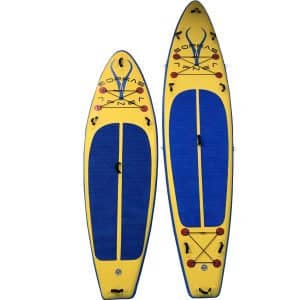
Freediving Boards vs. Standard SUP Boards
A standard stand-up paddleboard is designed for one person paddling on flat water. A freediving board is designed for a different set of demands: multiple divers resting simultaneously, a weighted dive line hanging beneath the board, equipment secured and accessible on the surface, and the board itself anchored in position against current and wind. The hardware that enables this — multiple grab handles, D-rings on top, sides, and bottom, bungee equipment-fixing points — is absent on consumer paddleboards and would need to be added at considerable cost and effort.
Both boards here are inflatable, which makes them practical for transport and storage. Inflated, they are rigid enough to support multiple divers and a dive line setup; deflated, they pack into the included backpack for transport to the site. This is a significant advantage over rigid boards for freedivers who travel to dive locations rather than diving from a fixed base.
The Two Boards
The Small freediving board measures 280×75×12 cm with a maximum load of 140 kg. The top surface has 4 grab handles on the sides and 1 central carry handle, plus 4 D-rings with bungee cord at the front for securing fins and other equipment. The underside has 3 D-rings — 2 at the rear and 1 at the front — for attaching a pulley system and counter-ballast line directly to the board. This is the correct choice for a solo diver with a safety partner, or for two divers working together with a single line setup.
The Large freediving board measures 350×75×15 cm with a maximum load of 180 kg. It scales up the hardware significantly: 8 grab handles on the sides (plus 1 central), 2 sets of 4 D-rings with bungee on the top surface (front and rear), 5 D-rings on the sides for anchoring the board to a fixed point to prevent drifting in current, and 4 D-rings on the underside in a front-and-rear configuration for heavier line and pulley setups. This is the appropriate board for groups, dive centre use, or any setup where multiple divers need to rest on the board simultaneously.
Both boards are supplied with a detachable centre fin, hand pump, retractable paddle, backpack for transport, and a repair kit. The centre fin improves directional stability when paddling to and from the dive site — without it, a wide inflatable board tracks poorly over any distance.
Line and Pulley Integration
Both boards are designed to work with a counter-ballast freediving line system. The D-rings on the underside accept carabiners for attaching pulleys and rope directly to the board, which then holds the weighted dive line beneath it. This eliminates the need for a separate buoy — the board itself serves as the surface float, the line attachment point, and the rest platform in a single piece of equipment.
The recommended setup uses two freediving pulleys and 50 metres of the Aqua 10 mm rope from the Freediving Lines subcategory. This allows the target depth to be adjusted from the surface without pulling the full weight of the line by hand. An upgrade to a sinking line is also possible with the same hardware.
For multi-diver training setups where a standard buoy would be impractical — a dive centre running a group session, or a team training for competition — the large board with a full pulley setup is effectively a portable freediving station that can be paddled to any location and anchored in position.
What to Look For
- Board size matched to your use case. The small board suits solo and paired diving with one safety diver; the large board handles groups and multi-diver setups. Maximum load is the hard limit — account for the combined weight of everyone who might rest on the board simultaneously, plus equipment.
- D-ring configuration for your line setup. If you plan to hang a dive line and pulley system from the board, confirm the underside D-ring positions work with your hardware. The large board’s front-and-rear bottom configuration handles heavier counter-ballast loads than the small board’s arrangement.
- Side D-rings for anchoring. Only the large board has D-rings on the sides for attaching an anchor line to prevent the board from drifting in current. If you regularly dive in locations with significant water movement, this is a meaningful difference between the two options.
- Inflation pressure and rigidity. An under-inflated board flexes under load, which affects both comfort and the stability of the line hanging beneath it. Use the included pump and inflate to the recommended pressure — the boards are thicker than standard SUPs (12 cm and 15 cm respectively) specifically to provide the rigidity needed for multi-person loading.
Maintenance and Care
Rinse the board thoroughly with fresh water after every saltwater session, paying particular attention to the D-rings, bungee attachment points, and valve. Salt accumulation around metal fittings causes corrosion over time, and salt crystals in the valve mechanism can cause it to leak or fail to seal.
Deflate and dry the board fully before storing — storing a damp inflatable board promotes mould growth on the interior material and at seams. Leave the valve open during drying to allow air circulation through the interior. Store loosely rolled rather than tightly folded; tight folds at the same crease line repeatedly weaken the material.
Inspect seams periodically and use the included repair kit for any punctures or delamination before they expand. A small seam separation that is repaired immediately takes five minutes; the same separation ignored for a season may require professional repair or board replacement.
Check bungee cord elasticity on the equipment-fixing D-rings. UV exposure degrades bungee cord faster than the board material itself — a bungee that no longer retracts firmly will not hold fins securely. Replace bungee sections as needed rather than relying on worn cord to secure expensive equipment.
Store the board away from direct sunlight when not in use. The combination of internal pressure and UV exposure causes PVC drop-stitch material to age faster when left inflated in direct sun over extended periods.
FAQ
Can I use a freediving board as a regular SUP paddleboard?
Yes — both boards include a retractable paddle and centre fin, and function as paddleboards for transit to and from the dive site. They are wider and more stable than performance SUP boards, which makes them slower to paddle but easier to stand on. The hardware on the top surface (D-rings, handles) adds minor resistance when paddling but does not significantly impede normal use.
Do I still need a separate buoy if I have a freediving board?
In most setups, no — the board itself serves as the surface marker and line attachment point, replacing the buoy entirely. You may still want a small torpedo buoy or flag attached to the board for visibility to boat traffic, particularly in areas where a flat board sitting low in the water might not be visible from a distance at speed.
How long does inflation take?
With the included hand pump, inflation to full pressure takes approximately 10–15 minutes for the small board and 15–20 minutes for the large board. An electric pump compatible with standard SUP valves reduces this to 3–5 minutes and is a worthwhile addition for regular use, particularly for the large board.
How many people can rest on the large board simultaneously?
The large board has 8 side handles and a maximum load of 180 kg. In practice this supports two to three adult divers resting at the edge simultaneously, with equipment stored on the central surface. For larger groups, multiple divers typically rotate through the rest position rather than loading the full group at once. Stay within the stated maximum load limit regardless of the number of people involved.
What’s included in the repair kit?
The included repair kit contains PVC patches and adhesive for field repairs of punctures and minor seam separations. It is not intended for major structural damage but handles the most common issues — small punctures from contact with rocks or boat hardware, and minor valve leaks. Keep the kit accessible in the included backpack rather than stored separately, so it is always available at the dive site.