


Showing the single result
A monofin is the most efficient propulsion tool in freediving — and the most demanding to master. Both feet sit in a single wide blade, driven not by an alternating leg kick but by an undulating, whole-body dolphin motion that channels power from the core and hips through the legs into one continuous wave. Done well, it delivers more thrust per unit of effort than any bi-fin. The trade-off is a steep learning curve and a narrow range of use: a monofin is a tool for dynamic apnea, depth disciplines, and finswimming, not for casual recreational diving or spearfishing.
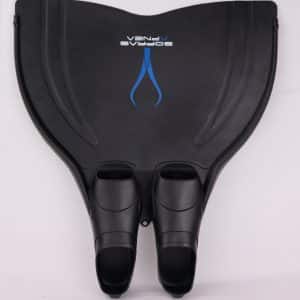
How a Monofin Works
A monofin joins both feet to a single broad blade, which fundamentally changes the propulsion mechanism. Where bi-fins are driven by an alternating flutter kick from the legs, a monofin is powered by the dolphin kick — an undulating wave that begins in the core and hips, travels down through the thighs and knees, and finishes at the blade. The whole body becomes the engine, not just the legs. This recruits the large, powerful muscles of the trunk and hips that a flutter kick leaves largely unused, which is why a well-driven monofin is more efficient than any pair of bi-fins.
That efficiency is the entire reason monofins exist in freediving. In dynamic apnea (horizontal distance on a single breath) and constant-weight depth diving, the metabolic cost of propulsion directly limits performance — every unit of oxygen spent moving is oxygen not available for breath-hold. A monofin that converts whole-body undulation into thrust with minimal waste extends both distance and depth on the same breath. This is why competitive freedivers in distance and depth disciplines almost universally use monofins.
The Learning Curve
A monofin is not a fin you simply put on and use. The dolphin kick is a coordinated, full-body technique that is not intuitive and takes dedicated practice to develop. A beginner on a monofin is typically slower and less efficient than the same diver on bi-fins, because the technique is not yet there to unlock the monofin’s advantage. The efficiency gain is real but conditional — it appears only once the undulation is properly coordinated, the timing is smooth, and the body has the core and hip flexibility the motion demands.
For this reason, a monofin is best approached as a deliberate skill to learn rather than a quick equipment upgrade. Many freedivers develop bi-fin technique first, then add a monofin specifically for distance and depth training once they are committed to those disciplines. Pool sessions are the natural place to learn the dolphin kick — controlled environment, short repeatable distances, and easy observation of technique.
When a Monofin Is — and Isn’t — the Right Tool
A monofin excels in a specific set of applications: dynamic apnea, constant-weight depth diving, and finswimming. In each, the diver moves in a straight line, technique is refined, and maximum propulsion efficiency is the goal. In these contexts nothing matches a monofin.
Outside them, a monofin is the wrong tool. It offers almost no manoeuvrability — you cannot turn quickly, change direction precisely, or hover and adjust position the way bi-fins allow. It is impractical near structure, in confined spaces, or anywhere requiring fine control. It cannot be walked in on land or at the surface. For these reasons a monofin is not suitable for spearfishing or general recreational diving, where manoeuvrability and versatility matter more than straight-line efficiency. Choosing a monofin is choosing to specialise.
What to Look For
- Commitment to the discipline. A monofin rewards dedicated technique practice and underperforms without it. Choose one if you are training for distance or depth and prepared to invest in learning the dolphin kick — not as a casual upgrade expecting an immediate gain.
- Foot pocket fit for both feet. Both feet share the monofin’s foot pockets, and the fit must be snug and symmetrical, worn over neoprene socks. A loose or uneven fit wastes power and disrupts the undulation. Size to the socks you actually dive in.
- Size and stiffness variant matched to you. Monofins come in variants — check the options on the product page and match the size and stiffness to your body and intended use. As with any composite or plastic blade, a stiffness that is wrong for your weight and strength undermines efficiency.
- Discipline match. Confirm the monofin suits your target use — pool dynamic apnea, depth, or finswimming. A pool-oriented session and a depth dive place different demands on the diver, though the fundamental dolphin-kick technique is shared.
- Transport and storage provision. A monofin’s single wide, rigid blade is large and awkward to transport and vulnerable to damage from point loads. Factor in a dedicated monofin bag with blade protection before committing.
Maintenance and Care
Rinse the monofin thoroughly with fresh water after every session, paying attention to the foot pocket interiors and the junction where the foot pockets meet the blade, where salt and sand accumulate. Dry away from direct sunlight before storage.
Store the monofin flat or hanging — never standing on the blade or with weight resting on it. The single wide blade can take a permanent set or develop stress points if stored under load or against a hard edge. If the monofin came with a blade protector, use it whenever the fin is not in the water.
Transport is where monofins are most often damaged. The large, rigid blade is awkward to carry and vulnerable to point loads, edge impacts, and being crushed under other gear. A dedicated monofin bag with rigid or padded blade protection is strongly recommended — a damaged blade is expensive and often not economically repairable.
Keep the blade away from prolonged UV exposure and heat, both of which degrade blade materials over time, gradually reducing responsiveness and, in extreme cases, weakening the structure. Do not leave a monofin in a closed car in direct sun.
Inspect the blade and the foot-pocket-to-blade junction periodically for cracks, delamination, or stress marks, particularly where load concentrates near the foot pockets. A small crack will propagate under the repeated full-body load a monofin transmits — catch it early.
FAQ
Is a monofin harder to learn than bi-fins?
Yes, considerably. The dolphin kick is a coordinated whole-body undulation that is not intuitive and requires dedicated practice to develop. A beginner is usually slower and less efficient on a monofin than on bi-fins, because the efficiency advantage only appears once the technique is properly coordinated. Most divers learn the dolphin kick in a pool, where the controlled environment and short repeatable distances make it easier to refine timing and body position. Expect the monofin to feel worse than bi-fins at first and better once the technique develops.
Can I use a monofin for spearfishing or recreational diving?
No — a monofin is the wrong tool for both. It offers almost no manoeuvrability: you cannot turn quickly, hover, change direction precisely, or work near structure the way bi-fins allow. It is impractical in confined spaces and cannot be walked in at the surface or on land. Spearfishing and general recreational diving demand versatility and fine control, which bi-fins provide and a monofin does not. A monofin is a specialist tool for straight-line distance and depth.
Why is a monofin more efficient than bi-fins?
A monofin is powered by the dolphin kick, which recruits the large, powerful muscles of the core and hips — muscles that the alternating flutter kick of bi-fins leaves largely unused. By turning the whole body into a single propulsive wave and channelling that power through one wide blade, a monofin converts effort into thrust with less waste. The result is more distance or depth per unit of oxygen spent — which is decisive in dynamic apnea and depth disciplines, where propulsion efficiency directly limits performance. The advantage only materialises with good technique.
Do I need a special bag to transport a monofin?
It is strongly recommended. A monofin’s single wide, rigid blade is large, awkward to carry, and vulnerable to point loads and edge impacts — and transport is where monofins are most often damaged. A dedicated monofin bag with rigid or padded blade protection prevents the blade from being crushed or struck during transport and storage. Given that a damaged blade is expensive and often not economically repairable, the bag is a sensible investment rather than an optional extra.
Do I wear socks with a monofin?
Yes. Like bi-fins, a monofin is worn with neoprene socks, which provide fit, thermal protection, and prevent chafing. Both feet share the monofin’s foot pockets, so a snug, symmetrical fit over the socks you actually dive in is important — a loose or uneven fit wastes power and disrupts the undulation that drives the fin. Size the foot pockets to the sock thickness you use.