


Showing all 4 results
Carbon and fiberglass blades are where freediving fins stop being equipment and start being performance. Compared to plastic, a composite blade returns far more of the energy you put into each kick — less effort per stroke, less lactic build-up, more depth or distance on the same breath. This category covers four composite fins: the Carbon Fins detach, the fiberglass HF 200 camo, and the carbon HF 300 and HF 400. The choice between carbon and fiberglass, and between blade stiffnesses, comes down to your weight, leg strength, and discipline.
Why Composite Blades Outperform Plastic
A freediving fin works by storing energy during the loading phase of a kick and releasing it during the recovery — the blade flexes, then springs back. Plastic blades lose a significant proportion of that energy to internal damping; the material flexes but returns the stored energy inefficiently and inconsistently. Carbon and fiberglass blades are far more elastic: they flex smoothly under load and return that energy in a clean, responsive snap. The practical result is a fin that propels you further per kick with less muscular effort — which directly translates to lower oxygen consumption and longer, deeper, more comfortable dives.
The difference is most noticeable on long dives and repeated descents. A diver who fatigues less per kick conserves oxygen, recovers faster between dives, and maintains cleaner technique deeper into a session. For anyone diving regularly beyond the beginner stage, a composite blade is the single upgrade that most changes how diving feels.
Carbon vs. Fiberglass
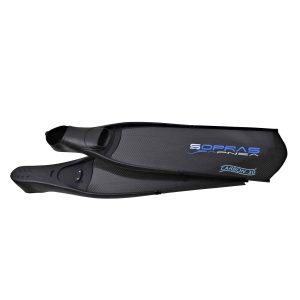
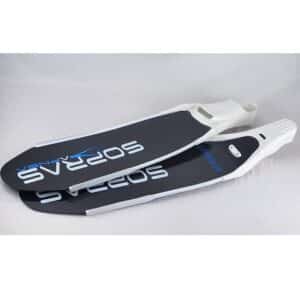
Carbon fiber is the premium choice. It is lighter, more responsive, and returns energy more efficiently than fiberglass at the same stiffness. The snap is crisper and the reaction quicker, which experienced divers feel immediately. The trade-off is cost and fragility: carbon is more expensive and more vulnerable to impact damage, point loads, and cracking if mishandled. The HF 300, HF 400, and Carbon Fins detach are the carbon options in this range.
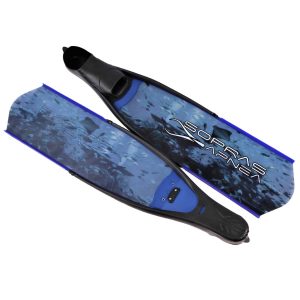
Fiberglass delivers most of the performance benefit of carbon at a more accessible price and with greater durability. It is slightly heavier and marginally less responsive, but considerably more forgiving of the knocks and point loads that occur in real-world use — boat decks, rocky entries, transport. The HF 200 camo is the fiberglass option, and its camouflage finish also suits spearfishers who want composite performance without the carbon price or fragility. For a first composite fin, or for diving in environments where the blades take regular contact, fiberglass is often the more sensible choice.
Blade Stiffness and Diver Match
Composite blades come in stiffness grades — commonly soft, medium, and hard. Stiffness is not a quality ranking; it is a match to the diver. The correct stiffness depends on three factors: body weight, leg strength, and discipline. A heavier or more powerful diver overloads a soft blade, collapsing it past its efficient flex range; a lighter diver cannot load a stiff blade enough to make it return energy. The blade should flex fully and spring back through the diver’s natural kick cadence.
As a general guide: soft blades suit lighter divers, those with less developed finning technique, and dynamic pool disciplines where cadence is high and effort sustained; medium blades are the versatile all-round choice for most recreational and depth freedivers; hard blades suit heavier or more powerful divers, those carrying weight, and high-load applications. When in doubt between two grades, the softer option is usually the safer choice — an under-loaded stiff blade wastes effort, while a slightly soft blade still returns energy.
Foot Pockets, Blade Angle, and Detachable Systems
The foot pocket transfers your leg power into the blade, and its fit and stiffness matter as much as the blade itself. A pocket that is too loose wastes energy and causes cramping; one that is too tight restricts circulation and accelerates cold. Most composite fins are worn with a thin neoprene sock for fit and warmth. The blade angle — the angle between the foot pocket and the blade, typically around 20–30° — pre-orients the blade into the water flow so that more of each kick produces forward thrust rather than being lost.
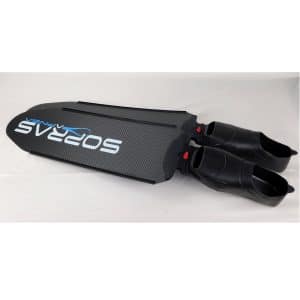
The Carbon Fins detach use a detachable blade system: the blade separates from the foot pocket, which allows blades to be replaced if damaged, swapped for a different stiffness as technique develops, or removed for more compact transport. For a diver who expects their needs to change — or who wants to protect a carbon blade by transporting it separately — a detachable system adds meaningful flexibility over a fixed-blade fin.
What to Look For
- Material matched to your priorities. Carbon for maximum efficiency and response, accepting higher cost and greater care; fiberglass for most of the benefit with better durability and a lower price. For a first composite fin or contact-prone environments, fiberglass is often the smarter buy.
- Stiffness matched to your weight and strength. This is the most consequential decision and the one most often got wrong. A blade that is too stiff for you wastes effort; one too soft bottoms out. Match stiffness to your body weight, leg power, and whether you carry weight.
- Foot pocket fit with your sock. Composite fins are worn with a neoprene sock. Size the pocket to fit snugly over the sock you actually dive in — a pocket fitted to a bare foot will be too loose with a 3 mm sock, and one fitted over a thick sock will cramp a bare foot.
- Detachable vs. fixed blade. A detachable system (Carbon Fins detach) allows blade replacement, stiffness changes, and compact transport. A fixed blade is simpler and marginally more efficient in power transfer. Choose detachable if you expect your needs to evolve or value transport protection.
- Blade protection for transport. Composite blades — carbon especially — are vulnerable to point loads and impact. Factor in a dedicated fin bag with blade protection; a cracked carbon blade is not economically repairable.
Maintenance and Care
Rinse fins thoroughly with fresh water after every session, paying attention to the foot pocket interior and the foot-pocket-to-blade junction where salt and sand accumulate. Dry away from direct sunlight before storage.
Store fins flat or hanging vertically by the foot pocket — never standing on the blade tips or with weight resting on the blades. A composite blade stored under load or against a hard edge can take a permanent set or develop stress points over time. If the fins came with blade protectors, use them whenever the fins are not in the water.
Carbon blades require particular care during transport and handling. Avoid point loads — do not stack heavy gear on top of the blades, do not let the tips strike hard surfaces, and never step on a blade. A dedicated fin bag with rigid or padded blade protection is a worthwhile investment that costs far less than a replacement blade.
Keep composite blades away from prolonged UV exposure and heat. Both degrade resin matrices over time, gradually reducing the blade’s responsiveness and, in extreme cases, weakening the structure. Do not leave fins in a closed car in direct sun.
Inspect the blade surface periodically for cracks, delamination, or stress whitening, particularly near the foot pocket junction where load concentrates. A small crack in a composite blade will propagate under repeated flexing — catch it early. On detachable systems, check the blade-to-pocket fixing periodically and confirm it is secure before diving.
FAQ
Is carbon really worth the extra cost over fiberglass?
For experienced divers who dive regularly and notice the difference, yes — carbon’s lighter weight and crisper energy return are felt on every kick and add up over a session. For newer divers, those on a budget, or anyone diving in contact-prone environments, fiberglass delivers most of the performance benefit at a lower price and with significantly better durability. Carbon’s advantage is real but incremental over a good fiberglass blade; the fragility and cost are also real. Match the choice to your level and conditions rather than buying the most expensive option by default.
How do I choose the right blade stiffness?
Match stiffness to your body weight, leg strength, and discipline. Lighter divers and those with developing technique are better served by softer blades; heavier or more powerful divers, and those carrying weight, need stiffer blades to avoid bottoming out the flex. Medium is the safe all-round starting point for most recreational depth freedivers. If you are between two grades, the softer one is usually the safer choice — a slightly soft blade still returns energy, while a blade too stiff for you simply wastes effort.
Do I need a neoprene sock with these fins?
Yes. Composite freediving fins are designed to be worn with a thin neoprene sock, which provides both fit and thermal protection and prevents chafing and blisters during long sessions. Size the foot pocket to fit snugly over the sock thickness you actually dive in. Diving these fins barefoot results in a loose, inefficient fit and is uncomfortable over any distance.
What is the advantage of the detachable blade system?
The Carbon Fins detach allow the blade to separate from the foot pocket. This means a damaged blade can be replaced without buying a whole new fin, blades can be swapped for a different stiffness as your technique and needs develop, and the fins pack down more compactly and safely for transport. A fixed-blade fin is marginally more efficient and simpler, but a detachable system offers more long-term flexibility — particularly valuable for protecting a carbon blade in transit.
How long do composite freediving fins last?
With proper care, a quality composite blade lasts many years — the limiting factor is usually impact damage or mishandling rather than wear. Carbon and fiberglass do not fatigue from normal flexing the way materials under extreme cyclic load might; the blade retains its responsiveness over a long lifespan if stored correctly and protected from point loads, UV, and heat. The most common cause of premature failure is a cracked blade from a transport accident or stepping on it — which is why blade protection and careful handling matter more than any maintenance routine.